
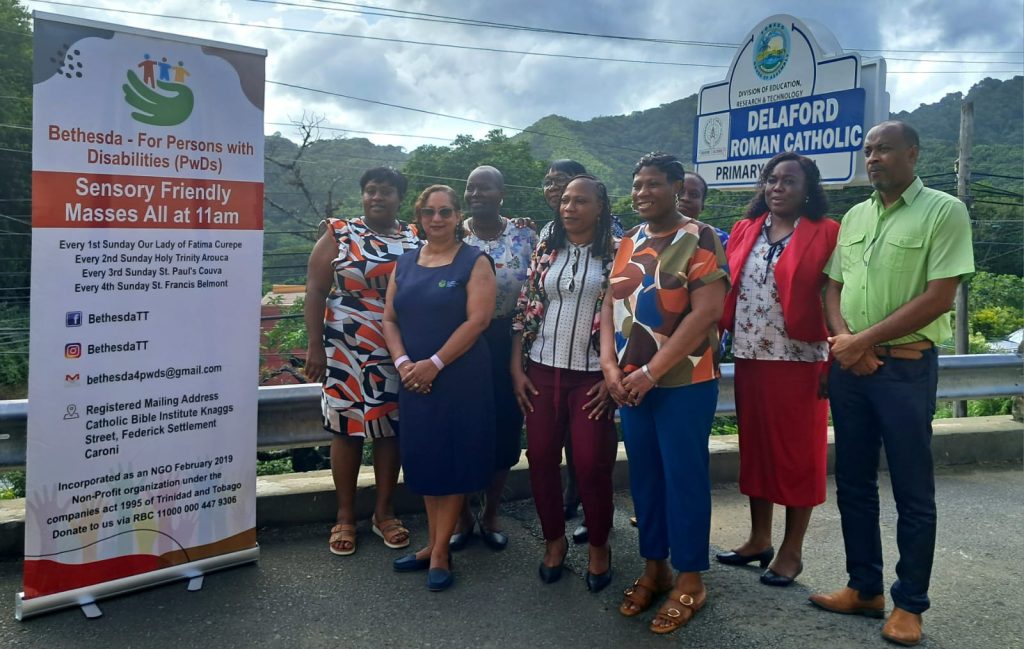
Saira La Foucade, Director of Bethesda—For Persons with Disabilities, recently visited Tobago as part of ongoing efforts to promote disability inclusion in Catholic education and to strengthen support for families of children with disabilities.
The Disability Inclusion Training Programme forms part of Bethesda’s advocacy to equip catechists and teachers with the knowledge and skills needed to include children with disabilities in mainstream classrooms.
Initially focused on catechists, the initiative has expanded to include Catholic school teachers, following growing interest from educators who participated in earlier sessions.
Working through the Archdiocesan Family Life Commission and Fr David Khan as head of the Catholic Education Board of Management (CEBM), Bethesda identified Catholic primary schools as an important starting point for early intervention and the promotion of inclusive learning environments.
 During the Tobago visit, first on the agenda was training for the catechists in Scarborough RC. Thirteen catechists were led by the Scarborough Vicariate Catechist Coordinator, Bernadette Phillips, along with Tobago Catholic Education Board Representative Mary Rogers, on October 10.
Delaford RC Primary School was our inaugural school to launch this advocacy programme on October 12, with all of the 10 staff members in attendance. It was very encouraging and the Tobago welcome was in full effect.
Scarborough RC Primary School followed on October 13. Training was conducted with 20 of the teaching staff, the guidance counsellors, librarian, and Acting School Principal Hamlet Gibbs.
 Each school was gifted with a large yoga ball and a floor mat from Bethesda to help establish a ‘Sensory Space’ to help children with disabilities regulate themselves and so in turn allowing them to be ready to be educated.
There was a positive response from both schools with interest for future sessions to help implement the recommended strategies and to improve their space towards greater inclusion.
The team also visited Happy Haven on October 15, a special education school celebrating its 50th anniversary on October 16, to explore further opportunities for collaboration. Principal Levis McNeil-Stewart was very open and welcoming towards working with Bethesda.
A key development was the partnership with Happy Haven to establish a sibling support group for brothers and sisters of persons with disabilities. Bethesda launched its own sibling support group in April 2024 and is now an internationally recognised ‘Sibshop’ group to address the needs of what are often described as ‘invisible children’—siblings whose emotional and social needs may be overlooked as families navigate the challenges of caring for a child with a disability.
Through this initiative, Bethesda aims to empower siblings by providing a safe space for shared experiences, understanding and mutual support. The proposed Happy Haven group will be led by siblings who will receive appropriate training by Bethesda to facilitate and sustain the programme.
For further information on ‘Sibshops’ we can be contacted via bethesdasibshop@gmail.com
The Tobago programme also included plans to engage Healing for Horses, a disability-focused organisation, as Bethesda continues to build relationships with organisations working to improve the lives of persons with disabilities.
This Tobago visit was supported through monies raised at our annual Bethesda fundraiser. This covered programme-related expenses, including administration, accommodation, and transportation.
The positive response from schools and organisations in Tobago reflects the growing need for practical training and sustained support for inclusive education and families affected by disabilities.
With participating groups expressing interest in continued collaboration, Bethesda hopes to return next year to help strengthen implementation of the strategies introduced during the programme.
Through its work in disability inclusion and sibling support, Bethesda continues to encourage communities, schools and families to recognise the dignity, potential and needs of every person, while ensuring that children with disabilities and their siblings are not left behind.