
by Triston Gollop, AFLC’s Programme Coordinator
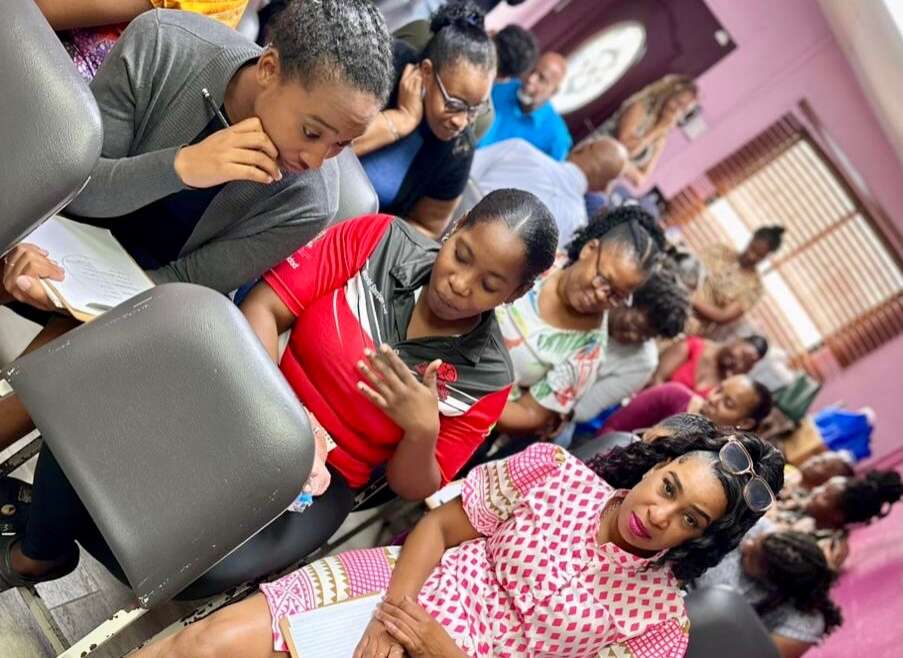
On Saturday, March 21, the Archdiocesan Family Life Commission (AFLC) gathered participants at the Belmont Pastoral Campus (BPC) for a comprehensive training session for new facilitators of the ‘Children Are A Gift’ programme. This is a faith-based initiative designed to help parents nurture their families through prayer, love, self-awareness, and discipleship.
Initially, I attended to assist with the co-ordination of the day but, as the sessions went on, I found myself becoming a facilitator in training.
Hosted and facilitated by Tricia Syms and Alicia Hoyte, the day began with introductions and breakfast, creating a warm, communal atmosphere. After welcoming participants with prayer, the morning sessions focused on two concepts of interconnectedness, ‘love as the foundation of family life’ and ‘the necessity of parental self-care’.
Through an interactive yarn activity, facilitators experienced how love physically connects and binds families together. It looked awkward at first, but as the facilitators passed the yarn around, you began to see the true beauty of the exercise—through the threads of love, we are all connected.
The ‘Understanding Yourself’ session was a bit more difficult, as it is at this point, I began my integration beyond co-ordinator. As we explored the four aspects of the human person, physical, emotional, intellectual, and spiritual needs, I began to realise that I have to be more intentional about caring for myself.
Then came the fatherhood segment. Led by myself, I spoke to fatherhood from a son’s perspective. This was perhaps the most difficult part of the day, as it was the first time I would have ever shared certain aspects of my life with people other than my wife. However, though challenging, I knew there was worth in my testimony, and I hope inspired understanding on the importance of a father.
We took a break for lunch and then went through the developmental stages of a child, but with a twist. We got into teams of three and were all given developmental descriptors (physical, social, emotional, cognitive) of what a child would need at different ages.
Our role as a team was to go through the descriptors and pair them with the appropriate age and need. This was a fun and interactive way to learn about the developmental stages.
In the final session of the day, we learned the difference between discipline and punishment. We learnt how discipline teaches while punishment shames, how discipline happens before and punishment after. This session allowed for further introspection. How was I raised? What are the norms within our communities? Is it discipline? Is it punishment?
Regardless of the answer to these questions, we were challenged to be disciplinarians through a fun clay exercise. We were challenged to think about difficult situations with our children and mould the clay to show how we would handle them with discipline instead of punishment. My hands were messy, but my mind was clearer.
By the session’s end, I understood that facilitation is not about having all the answers, but rather about creating space for others to find their own by staying neutral, actively listening, and asking the right questions.
I walked out of the BPC different than I walked in, more aware of my own wounds, more hopeful about healing, and clearer about the parent I want to be.
If you are interested in becoming a facilitator or would like more information on how to start or be a part of a Parental Support Group at your parish reach out to us at 299-1047 or aflc.pc@catholictt.org. Parenting is not an easy task, but you do not have to endeavour alone. Contact us today!