
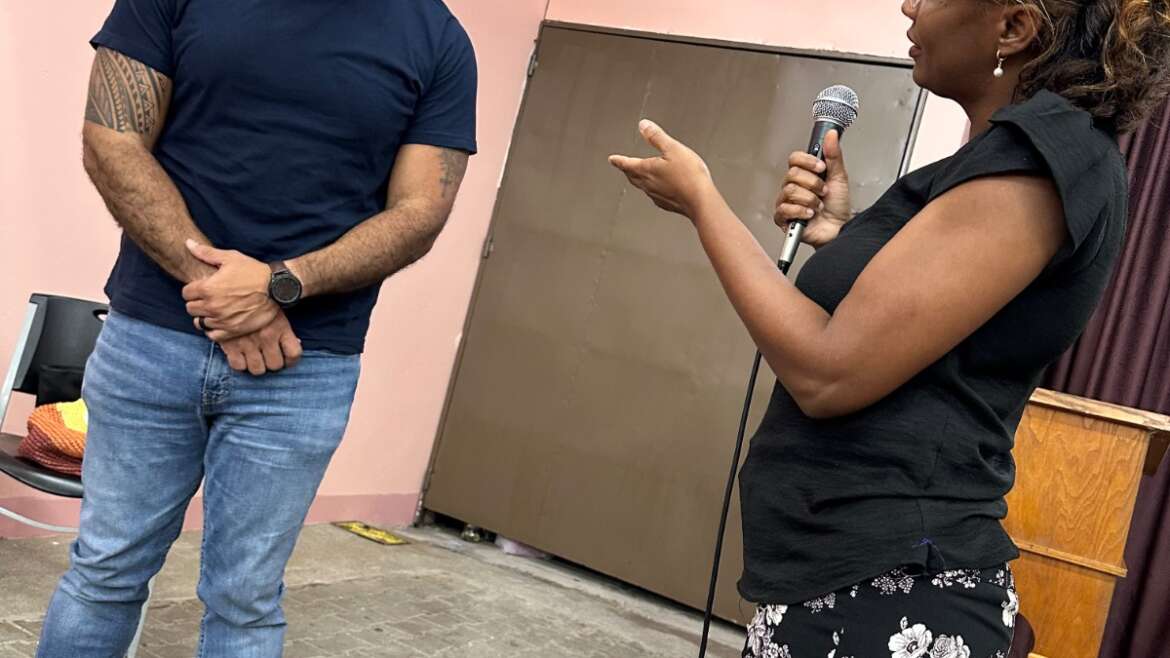
“Why are they always on the phone?” “Why do I only get one-word answers?” These were among the honest questions parents brought to the Santa Rosa Parent Support Group on Sunday, November 1, 2026, where the topic was having difficult dialogues with teens.
The session is part of the Archdiocesan Family Life Commission’s Parenting Accompaniment initiative in parishes, which journeys with parents as they become missionary disciples and strengthen their domestic church. Begun in April, the sessions continue monthly, drawing mainly parents from the Confirmation programme and open to all parents.
Facilitator Alicia Hoyte shared three keys. The first begins with the brain. Using Dr. Dan Siegel’s hand model, parents saw that the palm and wrist represent the cerebellum and brain stem, the home of basic instincts. The thumb represents the limbic system, which manages emotions, and the folded fingers represent the pre-frontal cortex, the logic centre. Many teenagers, parents learned, are operating from the limbic system. Hence the reminder: “We have the power to regulate; we are meant to be their pre-frontal cortex.”
Regulation starts with breathwork, helping parents “bring our calm and not join their chaos.” Parents practiced co-regulation, sharing their calm with a child. It lessens emotional escalation, gives children a safe place to feel difficult emotions, and teaches them to manage those emotions in healthy ways.
The second key is to PLAN: Prepare with patience and presence, which tells a child, “I am here.” Listen with curiosity, using phrases like “Help me to understand…”. Ask to help rather than lecture, and offer Non-judgmental support: “I can see that makes you upset; here is what I am seeing…”
The third key is to repair the rupture: relate, rupture, repair, repeat. Children will make mistakes, and so will parents. By modelling confession, apology and seeking forgiveness, parents rebuild trust, support the child’s brain integration, and teach how to handle broken relationships. Repair comes through humility and ownership in an apology, reconnection through touch, and time.
Ms. Hoyte noted that “young people want to empty their brains before falling asleep.” Bedtime, chores in the kitchen or cooking together can become natural spaces for co-regulation. Praying together, seeking forgiveness, listening and saying sorry keep the conversation open.
The next session is scheduled for January 2027.
Want to learn more? Email familylife@catholictt.org, visit aflcrc.org, and follow us on Instagram and Facebook @familylifecommission.